Lewis Rice

Inclusion at Lewis Rice

Inclusion at Lewis Rice

At Lewis Rice, we believe inclusion is more than a value. It is a key to better thinking, better service, and better outcomes. For over a century, we have understood that bringing together people with different experiences, perspectives, and strengths makes our firm stronger and our work more effective.

A Legacy of Inclusivity

When our founders, Joseph W. Lewis and Charles M. Rice, established the firm in 1909, their partnership challenged the norms of the time. In an era when law practices were often separated along religious lines, they brought together different faiths, educational paths, personalities, and work styles to build something lasting. That spirit of collaboration remains at the heart of our culture.

Living Our Values

Long before diversity and inclusion became standard language in the legal industry, Lewis Rice was putting those values into practice. We were one of the first major law firms in St. Louis to promote an African American attorney to full equity partner. Women have played key leadership roles at the firm for decades, including more than 30 years of representation on our Management Committee and leadership of departments and strategic initiatives.

Looking Ahead

We are committed to fostering an inclusive environment where individuals are respected, supported, and evaluated based on talent and performance. We welcome attorneys and staff of all backgrounds, including different races, genders, religions, abilities, sexual orientations, and socioeconomic experiences.

This approach not only reflects who we are but also enhances the work we do for clients. The inclusive mindset established by our founders continues to shape the forward-thinking and collaborative firm we are today.

Hear From Our People

  • Jerina Phillips

    Vice Chair, DEI Committee

    Read my Q&A
  • Sarah Mullen

    Member, Education Practice Group Leader

    Read my Q&A

Inclusion
News

View all
  • Sharon Callahan Receives Missouri Lawyers Media 2026 Diversity & Inclusion Award

    August 21, 2026
    Sharon Callahan
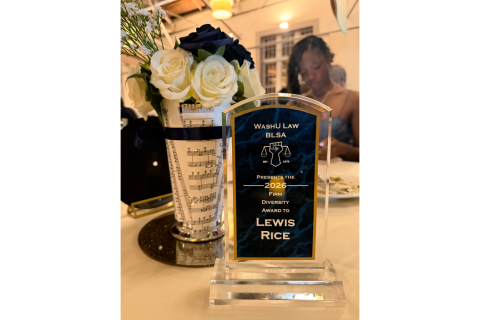
  • Lewis Rice Receives Firm Diversity Award from Washington University School of Law BLSA

    March 11, 2026
    Ronald A. Norwood, Jerina D. Phillips and Avrye Z. King
  • Lewis Rice Member Jerina D. Phillips Receives 2025 Diversity Champion Award

    August 29, 2025
    Jerina D. Phillips
Quote: <p>&ldquo;Diversity in legal teams facilitates the ability to think creatively, to craft comprehensive solutions that address all aspects of a given legal challenge, and to offer clients the most desirable outcomes.&rdquo;</p>
 - Ronald A. Norwood

“Diversity in legal teams facilitates the ability to think creatively, to craft comprehensive solutions that address all aspects of a given legal challenge, and to offer clients the most desirable outcomes.”

Ronald A. Norwood

Chair, DEI Committee

<p>As a Member Firm of the Leadership Council on Legal Diversity (LCLD), Lewis Rice is committed to directing material change within the Firm, in our community, and in the legal profession through hiring programs, training and development, relationship building, incentives programs, and more.</p>

As a Member Firm of the Leadership Council on Legal Diversity (LCLD), Lewis Rice is committed to directing material change within the Firm, in our community, and in the legal profession through hiring programs, training and development, relationship building, incentives programs, and more.

In November 2017, Lewis Rice proudly received the Corporate Diversity Award from the St. Louis American. This video is courtesy of The St. Louis American. 

  • Overview

  • Women to Women

  • Our Commitment

  • Committee

  • Deskins Fellowship

  • LawBridge Internship

Firm Highlights

  • Publication

    Unconstitutional Usurpation of Power: An Evaluation of the Corporate Transparency Act’s Potential Demise Under National Small Business United v. Yellen

    Matthew R. Hemmersmeier examines the constitutional arguments at issue regarding the Corporate Transparency Act (CTA) and how the District Court for the Northern District of Alabama reached its conclusion in National Small Business United v. Yellen that the CTA, as applied to the Plaintiffs, should be struck down as an unconstitutional usurpation of federal power. Click under "Resources" below to read the full article.

  • Firm News

    Federal Lawsuit Filed on Behalf of Polk County, Iowa, Landowners Whose Property was Taken by the Federal Government

    Lindsay S.C. Brinton and Meghan S. Largent, attorneys from Lewis Rice’s Federal Takings & Rails to Trails Practice, filed a case in the United States Court of Federal Claims on behalf of 29 landowners in Polk County, Iowa, on Aug. 7, 2026. The lawsuit alleges that the federal government owes the landowners compensation for their property that it authorized for public trail use. The federal Surface Transportation Board (STB) issued an order called a Notice of Interim Trail Use or Abandonment on July 31, 2026. This authorizes the cities of Des Moines, West Des Moines, Windsor Heights, Urbandale, Clive and Grimes to convert the abandoned 12.2-mile Norfolk Southern railway corridor known as the Grimes Line into a public hiking and biking trail. Because converting the rail line to a public trail is not authorized under Iowa law, the cities sought permission from the STB to acquire the rail line from Norfolk Southern Railway so the land could be put to public use. The STB granted that request, which gave rise to the landowners’ lawsuit. The lawsuit alleges that Norfolk Southern does not own the land underlying its rail corridor, but rather has operated the railroad across the land pursuant to century-old easements. Once the railroad is abandoned, those easements would have ceased to exist. “Pursuant to the National Trails System Act, the federal government has the constitutional authority to take these landowners’ property for conversion to a public-access recreational trail and preservation of a railroad easement,” Meghan said. “However, the Fifth Amendment to the United States Constitution requires the federal government to pay the landowners for the value of their property taken.” The lawsuit asks the Court to compensate each landowner for the fair market value of the property that will now be encumbered by the public recreational trail easement. The lawsuit is only against the federal government and makes no claims against Norfolk Southern Railway nor the cities involved in the transaction. The lawsuit does not aim to stop the transfer of the railroad property to the cities for a public trail nor does it seek to impact the funding for the proposed trail in any way. More than 200 landowners are currently eligible to make a claim for compensation. Lindsay and Meghan are continuing to add landowners to this case and plan to reach out to more along the corridor in the coming weeks. Lewis Rice's federal takings attorneys represent landowners throughout the United States pursuing takings claims against the federal government. One primary focus of the group is representing landowners in what is commonly referred to as rails to trails takings. Attorneys in this group litigate cases in the United States Court of Federal Claims on behalf of those whose property was taken by the federal government pursuant to the National Trails System Act, which authorizes abandoned railroad lines to be converted to public parks. The goal is to obtain compensation from the government for the taking of their land for the public recreational trail. The attorneys in the Federal Takings Practice Group focus on both proving the taking has occurred as well as establishing the value of the property that was taken. Their national work for landowners includes representing landowners coast-to-coast, including 11 states.

  • Firm News

    Lewis Rice Secures More Than $250,000 in Compensation for Bon Homme and Charles Mix County Landowners in Two Rails-to-Trails Cases

    Lindsay S.C. Brinton and Meghan S. Largent, attorneys from Lewis Rice’s Federal Takings & Rails to Trails Practice Group, recently secured more than $250,000 in compensation for six landowners in two lawsuits (Koepp et al. v. United States and Bambas et al. v. United States) in Bon Homme and Charles Mix counties in South Dakota. These landowners brought claims against the federal government for the taking of their property for a 24-mile hiking and biking trail between Tyndall and Ravinia. These were the third and fourth lawsuits concluded by the firm on behalf of landowners along this railroad corridor. In 2023, the corridor was converted to public trail use under the National Trails System Act, a federal law that allows unused railroad corridors to be turned into public recreational trails rather than returning to the underlying landowners. The lawsuits alleged that under South Dakota law, the abandoned railroad corridor over the landowners’ properties was operating pursuant to a century-old easement that would have been extinguished upon abandonment. However, in August 2023, the state of South Dakota, which owns the rail line, received permission from the federal government to convert the line to a hiking and biking trail. Because use of the railroad easement as a public park would not have been permitted under South Dakota law, the landowners alleged that the federal government took their private property for a public purpose without providing them with just compensation — a violation of the Fifth Amendment to the United States Constitution. In total, Lewis Rice has recovered more than $500,000 for 21 landowners along this rail-trail corridor. “There are more than 80 landowners in Bon Homme and Charles Mix counties who are still eligible to file a claim for the just compensation the federal government owes them,” Meghan said. “We will continue to help these landowners pursue the compensation they are legally entitled to.” Any landowners wishing to make a claim for compensation must do so prior to August 17, 2029. Lewis Rice's federal takings attorneys represent landowners throughout the United States pursuing takings claims against the federal government. One primary focus of the group is representing landowners in what is commonly referred to as rails to trails takings. Attorneys in this group litigate cases in the United States Court of Federal Claims on behalf of those whose property was taken by the federal government pursuant to the National Trails System Act, which authorizes abandoned railroad lines to be converted to public parks. The goal is to obtain compensation from the government for the taking of their land for the public recreational trail. The attorneys in the Federal Takings Practice Group focus on both proving the taking has occurred as well as establishing the value of the property that was taken. Their national work for landowners includes representing landowners coast-to-coast, including 11 states.

  • Firm News

    Lewis Rice Website Named a Winner in the 2026 WebAward Competition

  • Case Study

    Securing a Legislative Victory for the American Car Rental Association

    Lewis Rice member David W. Sweeney represented the American Car Rental Association (ACRA) in its effort to shape legislation governing the operations of Turo, an online car-sharing platform, at St. Louis Lambert International Airport. The initial bill would have permitted Turo to operate in airport garages within walking distance of passenger terminals, a proposal opposed by members of the St. Louis Airport Commission due to competitive concerns. David engaged with stakeholders to negotiate a revised agreement that addressed these objections while protecting the interests of ACRA. The final legislation limits Turo’s operations to three designated parking areas west of Terminal 1. The measure was opposed by the St Louis Airport Director but  approved unanimously by the St. Louis Board of Aldermen, marking a significant milestone in the legislative process. This outcome preserved competitive balance in the airport rental market and aligned with ACRA’s policy objectives. The case demonstrates how strategic advocacy and effective negotiation can deliver tangible results for industry associations facing complex regulatory challenges.

  • Publication

    Business Attorneys' Guide to AI and IP Rights in Transactions

    Actionable Guidance for Everyday Transactional Practice "Who owns the output when a business uses a third-party AI tool?" "What are the trade secret implications of employees' unauthorized use of consumer-level AI like ChatGPT?" "What is negotiable in AI vendor contracts, and how can we boost our leverage?" Your business clients are wrestling with a storm of new questions regarding AI that has permeated all aspects of law and business. And current regulatory and legal guidance is patchy at best. Do you have the critical IP knowledge to advise them in this rapidly changing market? This course breaks down the arcane concepts of IP and the technical jargon of AI to offer practical legal guidance for strengthening contracts and helping businesses protect their work product and trade secrets. Help your clients thrive in the brave new AI world. Abbreviated Agenda What Clients Are Actually Doing With AI - And Why It Creates Legal Work Where the Legal Risk Actually Is: AI Regulation, Liability, and Exposure Who Owns AI Output - and When It Matters Contracts in the Age of AI: Drafting for Clients Who Use or Build AI AI Due Diligence in M&A Transactions AI Governance and Trade Secret Protection Legal Ethics in Daily AI Use Click here for more information and to download this webinar.

  • Firm News

    Neal F. Perryman Named to Missouri Lawyers Media's POWER List for Employment Law

    Neal F. Perryman, Chair of Lewis Rice’s Litigation Department, has been selected for Missouri Lawyers Media's 2026 Employment Law POWER List, an honor recognizing the state's top employment attorneys. The recognition marks Neal's seventh consecutive year on the list. Neal focuses primarily on labor and employment law and litigation under the Employee Retirement Income Security Act (ERISA). Additionally, he has experience in complex commercial litigation, appellate advocacy, education law, and municipal law. He defends employers, universities, and municipalities in personnel-related disputes before state and federal courts, arbitration panels, and administrative agencies, and regularly advises clients on regulatory compliance, union contract negotiations, and governance practices. Since 1991, Neal has led some of the Firm's most consequential litigation matters. He secured summary judgment for an employer-sponsored plan in a significant cash-balance ERISA age-discrimination case, later affirmed by the U.S. Court of Appeals for the Seventh Circuit. He led the defense of a university in a Title IX case that produced a nationally significant decision from the U.S. Court of Appeals for the Eighth Circuit, and he guided the Lewis Rice litigation team through trial and appeal in a widely reported case challenging a law firm's mandatory retirement policy for partners. Much of Neal’s career has centered on the role employment law plays at the intersection of business, people, and problem-solving. “Every organization relies on its workforce to succeed, and employment-related decisions often have significant operational and legal implications,” he said. “I enjoy helping employers navigate those challenges, manage risk, and create workplaces where both people and businesses can thrive.” Beyond his litigation practice, Neal serves on Lewis Rice's Management Committee, Appellate Practice Review Committee, and Recruiting Committee, and is an active mentor to the Firm's junior attorneys. He is a Fellow of the Litigation Counsel of America's Trial Lawyer Honorary Society and a member of the American Bar Association's Labor and Employment Law Section, the National Association of College and University Attorneys, and several state and local bar associations. He also holds leadership roles with Westminster College and the St. Louis Zoological Park Subdistrict Commission.

  • Publication

    Taxed from Home: How Post-Pandemic Remote Work Magnifies the Constitutional Issues with Taxing Telecommuters

    Phoebe D. Leach examines the constitutional issues surrounding state taxation of telecommuters and the legal challenges facing certain remote worker tax regimes. Click under "Resources" below to read the full article.

  • Publication

    More than a Catchphrase: Trademark Lessons from the “Get Your Pink Back” Dispute

  • Publication

    California Legislature Eliminates Private Right of Action for Certain Claims Under CIPA

    On September 30, 2026, California Governor Gavin Newsom signed Senate Bill 690 (“SB 690”), which the California Legislature unanimously passed on August 28, 2026. The new law, which will take effect on January 1, 2027, eliminates the private right of action for online pen register and trap and trace claims under the California Invasion of Privacy Act (“CIPA”). Although SB 690 marks a substantial change to the CIPA landscape, which has been flooded with claims in recent years, it does not provide complete relief to companies that use commonplace online tracking technologies like cookies. Rather, the law shifts enforcement from private plaintiffs to the California Attorney General. Further, plaintiffs may try to challenge the same tracking technologies under other provisions of CIPA or other laws. Background CIPA was originally enacted in 1967. It prohibits any interception or recording of confidential communications of another without their consent. Broadly speaking, the law prohibits wiretapping, eavesdropping, the recording of private communications, and the use of pen registers or trap and trace devices. As relevant to SB 690, Section 638.51 of CIPA prohibits the installation or use of a pen register or trap and trace device without having first obtained a court order or consent. CIPA’s civil enforcement provision, Section 637.2, provides statutory damages of $5,000 per violation plus three times the amount of actual damages, if any, that a plaintiff sustains. Prior to the enactment of SB 690, CIPA provided individuals with a direct cause of action against any private actor for violations of the law. Over the past few years, the number of CIPA pen register and trap and trace lawsuits has exploded. Plaintiffs have used CIPA’s private right of action to threaten and/or bring thousands of claims, including class action lawsuits, against companies. By and large, these claims argue that companies violated CIPA’s prohibition on pen register and trap and trace devices through their use of common online tracking technologies, including cookies, third-party pixels, website analytics, and similar technologies. Plaintiffs typically allege that such technologies are pen registers or trap and trace devices and that companies violate Section 638.51 by using those technologies without a court order or consent. Plaintiffs in these actions seek the statutory damages of $5,000 per violation, which is the maximum amount recoverable without showing actual damages. Courts have determined that CIPA applies so long as the internet user is within California, meaning that companies based outside of California may still be subject to CIPA liability. Key Changes Effective January 1, 2027, SB 690 amends CIPA’s civil enforcement provision, resulting in two major changes.  Private plaintiffs can no longer file pen register and trap and trace claims for conduct occurring on an internet website, online application, or mobile application. Only the California Attorney General may bring such claims.  SB 690 is retroactive to January 1, 2025. Any lawsuit filed by a private plaintiff on or after January 1, 2025 that alleges an unlawful pen register or trap and trace device in connection with an internet website, online application, or mobile application will be barred. Cases filed prior to January 1, 2025 are left unaffected, as are civil enforcement claims brought by the California Attorney General. What SB 690 Has Not Changed Although the elimination of the private right of action for certain pen register and trap and trace claims is a major development that will bar many threatened and pending lawsuits, SB 690 is not a complete overhaul of CIPA.  Online pen registers and trap and trace devices are still illegal without a court order or consent. SB 690 only shifts the enforcement to the California Attorney General.  Plaintiffs still have a private right of action for wiretapping claims or eavesdropping claims. SB 690 specifies that only the California Attorney General may bring lawsuits alleging violations of Section 638.51. Private plaintiffs may still bring wiretapping claims under Section 631 or eavesdropping claims under Sections 632 and 637. These plaintiffs may still seek the $5,000 statutory damages for such violations of CIPA and may still potentially file class action lawsuits. Legislative action to curb these claims may be forthcoming. When Governor Newsom signed SB 690, he noted that “additional work in this area is needed, as CIPA contains other decades-old statutes that are also susceptible to abuse by overly aggressive litigants,” and he urged the California legislature to take this on next year to “ensure a fair balance between protection private information and preventing rapacious litigation.” Looking Forward While SB 690 is an important change, companies should remain vigilant with respect to the use of third-party tools within their websites and potential CIPA lawsuits. It is likely that plaintiffs will now allege that the same internet tracking technologies amount to wiretapping or eavesdropping violating Sections 631, 632, and 632.7 and seek the $5,000 statutory damages per putative violation, in addition to violations of other laws. Further, the California Legislature’s elimination of a private right of action for online pen register and trap and trace device cases does not eliminate the risk of suit under Section 638.51. The California Attorney General may pick up where private lawsuits have left off, though Governor Newsom stated that he is aligned with the “goal of protecting small businesses from overzealous lawsuits based on a statute written without today’s complex technological landscape in mind.” If you would like assistance with, or have any questions about, CIPA claims, please contact one of the authors of this alert.


  • Lewis Rice
    • Subscribe
    • Offices
    • Disclaimer
    • Privacy Policy
    • Cookie Policy
    • Cookie Preferences
    • Website Credits
    © 2026 Lewis Rice LLCAll Rights Reserved.