Client Alert
Is Green the New Black? The Rise of Greenwashing in the Fashion Industry
Emily K. Bardon, Lauren Rouse Carey
share this page:
As fashion brands continuously work towards reducing their carbon footprint through more sustainable products and practices, they must be mindful of how to communicate these efforts. Businesses like H&M, Nike, Kohl’s and Walmart, among others, have recently found themselves in lawsuits for alleged deceptive marketing strategies coined as “greenwashing.”
Defining Greenwashing
Greenwashing is the practice of overstating the environmental impacts of a product or service. These statements can manifest in several ways, including false or misleading claims about certain environmental benefits.
In an effort to help marketers ensure that environmental marketing claims are true and substantiated, the Federal Trade Commission (FTC) issued the Green Guides, which were most recently revised in 2012. For more information on the Green Guides, see our Client Alert here.
Below are examples of a couple of recent greenwashing lawsuits.
H&M
Abraham Lizama purchased a sweater from H&M’s “conscious choice” collection. According to Lizama, he believed this meant his sweater was made using “more sustainable and environmentally friendly” manufacturing practices. Lizama claimed that the product was not “environmentally friendly,” and brought a nationwide putative class action over the alleged misrepresentation.
Specifically, Lizama alleged that certain statements (including those noted in the table below) mislead consumers into thinking H&M’s products were sustainable. In its analysis the court noted that H&M never represented that its products were “sustainable” or even “more sustainable” than its competitors’ products. Rather, H&M stated that its conscious choice garments contained “more sustainable materials” and that the line included “its most sustainable products.” The court explained that no reasonable consumer would understand this representation to mean that the conscious choice clothing line is inherently “sustainable” or that H&M's clothing is “environmentally friendly” when neither of those representations were ever made.
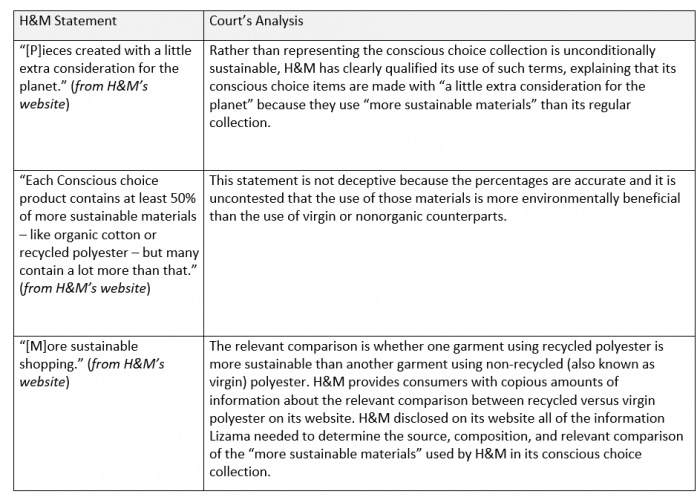
The court ultimately found H&M’s statements were appropriately qualified and substantiated and denied all of Lizama’s claims. One of the many lessons in this case is that businesses can benefit from being transparent with their environmental representations and their products, and they may avoid, or succeed in defending, lawsuits by substantiating such representations through publicly available information.
Nike
A complaint was recently filed (by the same law firm representing the plaintiffs in the H&M case described above) alleging that Nike falsely and misleadingly marketed certain products as sustainable and environmentally friendly. According to the complaint, the labeling of the relevant products included the following claims: “Sustainability;” “made with recycled fibers” which “reduces waste and our carbon footprint;” support a “Move to Zero” which “is Nike’s journey toward zero carbon and zero waste to help protect the future of sport;” and contained a circular symbol that meant that the products were made with “sustainable” and environmentally friendly materials. The plaintiff claims that Nike induced consumers to pay higher prices for what the consumers believed to be sustainable products. We will continue to monitor the outcome of this lawsuit.
Conclusion
If businesses are using greenwashing as a strategic technique to increase consumer demand, they may find themselves in hot water, especially if consumers are required to pay more for sustainable products as promised. If you need assistance or have any questions regarding environmental marketing claims, please contact one of our Design & Luxury attorneys.
Special thanks to Jessie L. O’Brien for her contributions to this article.